
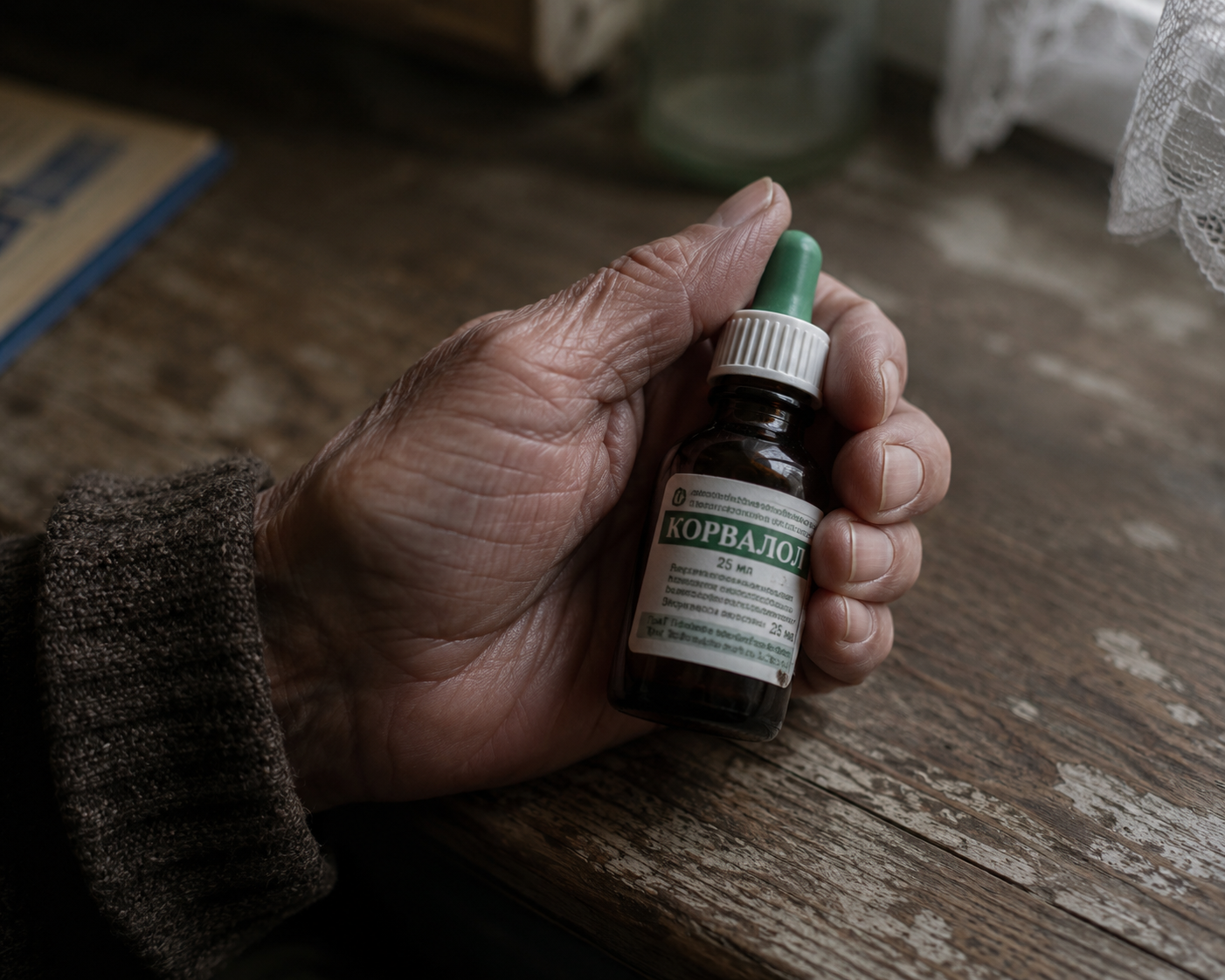
Hidden Barbiturate Dependence in the Elderly
Millions of elderly people in post-Soviet countries — and among migrant communities worldwide — unknowingly consume phenobarbital daily through common "heart drops" like Corvalol and Valocordin. This article explains the hidden dependence this creates, its serious risks, and how it can be recognized and treated.
On This Page
Introduction
While barbiturates have largely been replaced by safer sedative-hypnotics in Western medicine, phenobarbital persists through non-prescription sedative mixtures widely used across Eastern Europe and Central Asia. Products such as Corvalol and Valocordin are broadly perceived as harmless "heart drops," yet they contain pharmacologically active doses of phenobarbital — often consumed chronically by elderly individuals over many years.
This practice creates a unique epidemiological phenomenon: a hidden barbiturate-dependent population concentrated among older adults in Russia, Ukraine, Belarus, Kazakhstan, and among emigrant communities in Israel, Germany, the United States, and elsewhere.
Many elderly patients who use Corvalol or Valocordin daily do not consider themselves drug users and are unaware they are physically dependent on a barbiturate. Their physicians in Western countries are often equally unaware.
Pharmacology & Age-Related Risk
Phenobarbital is a long-acting barbiturate that enhances GABA-A receptor activity, producing CNS depression. Its key pharmacokinetic feature — a half-life of 53–118 hours (averaging ~79 hours, and often exceeding 100 hours in elderly patients) — means the drug accumulates with daily use far more readily than users realize.
| Property | General Adult | Elderly Patient |
|---|---|---|
| Half-life | 53–118 hrs (~79 hr mean) | Often >100 hrs |
| Hepatic clearance | Standard CYP450 metabolism | Reduced → accumulation |
| CNS sensitivity | Moderate | Increased → sedation, delirium |
| Polypharmacy risk | Lower | High (anticoagulants, antidepressants, opioids) |
| Dependence risk | Moderate with chronic use | Higher; shorter time to dependence |
The American Geriatrics Society explicitly classifies barbiturates as potentially inappropriate in older adults due to high risk of dependence, overdose, and cognitive impairment.
Clinical Effects in Elderly Populations
Chronic phenobarbital exposure in older adults produces a range of effects that are frequently misattributed to normal aging or other conditions, delaying recognition and treatment.
Neurological & Psychiatric
- Chronic sedation ("quiet decline")
- Cognitive impairment mimicking dementia
- Depression and emotional blunting
- Paradoxical agitation (rare)
Physical Consequences
- Ataxia → falls and fractures
- Hypotension → syncope
- Respiratory depression
- (Especially dangerous with alcohol or opioids)
Long-Term Outcomes
- Functional decline
- Social withdrawal
- Increased mortality from falls and CNS depression
Common Misdiagnoses
- Alzheimer's / Vascular dementia
- Depression
- Age-related gait disturbance
- Idiopathic hypotension
Dependence from "Low-Dose" Chronic Use
A key misconception in post-Soviet populations is that small daily doses of Corvalol are harmless. Clinically, this is incorrect. Because of phenobarbital's exceptionally long half-life, even modest daily use leads to drug accumulation and eventual steady-state physiological dependence.
Even 10–30 drops daily over months can produce physical dependence. Russian addiction medicine literature describes Corvalol dependence as "аптечная наркомания" — "pharmacy addiction" — a culturally normalized but clinically significant condition.
Patients and their families rarely frame this as substance use. The medication is perceived as a legitimate, even necessary, treatment for heart palpitations and anxiety — which makes identification and intervention particularly challenging.
Withdrawal Syndrome: Clinical Complexity
Withdrawal from phenobarbital is medically serious and potentially life-threatening. Its characteristics differ importantly from benzodiazepine withdrawal and must not be underestimated.
Core Withdrawal Features
- Anxiety and insomnia
- Tremor, autonomic instability
- Nausea and sweating
- Hallucinations and delirium
- Seizures (life-threatening)
Elderly-Specific Risks
- Higher risk of delirium
- Slower neurochemical recovery
- Increased mortality if unmanaged
- Longer overall withdrawal course
Abrupt cessation of chronic phenobarbital use can trigger seizures and delirium. Any attempt to stop should be done under medical supervision with a structured taper protocol.
Clinical Observations by Country
The following summarizes observations from addiction treatment settings across several countries where this issue has been documented.
- Addiction clinics report long-term Corvalol users presenting with withdrawal delirium
- Severe cases require ICU-level management
- Tapering is complicated by patients' belief that Corvalol is a "heart medicine," not a drug
- Phenobarbital is primarily encountered in detox settings or in patients with imported OTC drug use
- Protracted withdrawal documented even after controlled taper
- Dose reduction over weeks to months is typically required
- Russian-speaking immigrant populations continue importing or obtaining Corvalol locally
- Often misclassified as a "herbal sedative" by patients and primary care providers
- Cultural resistance to discontinuation; under-recognition in primary care settings
- Eastern European migrants continue using Valocordin (originally of German origin, now largely exported)
- German physicians report unfamiliarity with chronic barbiturate exposure via OTC drops
- Delayed diagnosis due to unrecognized source of exposure
Epidemiology & Sales Trends
Despite some decline from peak consumption, the absolute scale of Corvalol use remains enormous, particularly in Russia.
Ukraine has seen overall sedative/anxiolytic sales decline since 2022 due to wartime disruption, yet Corvalol remains among the top-selling sedative products by volume. In Belarus and Kazakhstan, the product continues to be sold over the counter without restriction.
Public Health Implications
Hidden Addiction Burden
- Millions potentially exposed chronically
- Elderly disproportionately affected
- Invisible in standard drug use surveys
Diagnostic Challenges
- Symptoms mimic aging or dementia
- Patients deny "drug use"
- OTC status normalizes continued use
Treatment Barriers
- Deep cultural normalization
- Unrestricted OTC availability
- Low awareness in Western healthcare
For Migrant Communities
- Language and cultural barriers to care
- Continued sourcing from home countries
- Primary care providers unfamiliar with products
Clinical Management Strategies
For clinicians encountering patients who use Corvalol, Valocordin, or similar products, the following approach is recommended.
Identification
Tapering Protocol
Abrupt cessation risks seizures and life-threatening delirium. Always use a gradual taper over weeks to months. Consider substitution protocols for severe dependence.
Monitoring During Withdrawal
Key Clinical Takeaways
- Corvalol and Valocordin contain phenobarbital, a barbiturate — not an herbal remedy.
- Even low chronic doses (10–30 drops/day) over months produce physical dependence.
- Withdrawal can be prolonged (2–5+ weeks) and life-threatening if mismanaged.
- Elderly patients face heightened risks of delirium, falls, cognitive decline, and prolonged recovery.
- Clinicians in Western countries should screen for Corvalol use in post-Soviet immigrant patients.
- Abrupt cessation must be avoided; a structured, supervised taper is essential.
Conclusion & Future Directions
Phenobarbital exposure through Corvalol and similar preparations constitutes a significant, under-recognized source of dependence and morbidity in elderly populations, particularly across Eastern Europe and among migrant communities globally. Post-2022 data confirm that despite declining trends, tens of millions of packs are still sold annually.
Clinicians worldwide — especially those serving post-Soviet immigrant populations — must recognize this hidden barbiturate exposure, screen appropriately, and manage withdrawal with the seriousness the syndrome demands. Cultural reframing of these products, combined with physician education and consideration of regulatory review, are the essential next steps.
Cross-national epidemiological studies across Russia, the EU, Israel, and the USA · Education programs for primary care providers in migrant-dense regions · Regulatory reconsideration of OTC phenobarbital-containing products